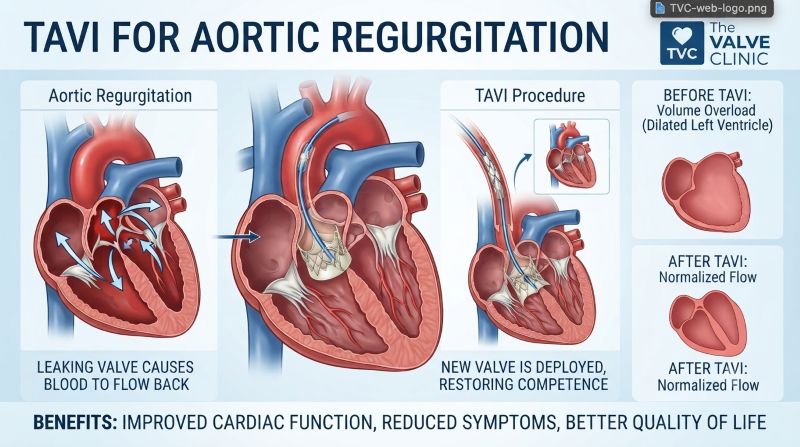
TAVI for aortic regurgitation may be an option for selected patients with a leaky aortic valve, although it is not suitable for everyone. While transcatheter procedures were originally developed for narrowed aortic valves, advances in valve technology now allow some people with severe aortic regurgitation to benefit from a minimally invasive treatment after careful evaluation by an experienced heart team.
When the aortic valve does not close properly, blood flows backwards into the heart instead of moving efficiently through the body. Over time, this extra workload can enlarge the heart and eventually reduce its pumping ability. Traditionally, surgical valve replacement has been the standard treatment. However, modern catheter-based procedures are expanding treatment options for patients who may not be ideal candidates for open-heart surgery.
What Is Aortic Regurgitation?
Aortic regurgitation, often called a leaky aortic valve, occurs when the valve between the heart and the aorta does not close completely. This allows blood to leak back into the left ventricle after every heartbeat.
Mild leakage may not cause symptoms for many years. As the condition progresses, the heart must work harder to maintain normal blood flow.
Common symptoms include:
- Breathlessness during activity
- Fatigue
- Chest discomfort
- Palpitations
- Reduced exercise tolerance
- Swelling in the legs in advanced cases
Doctors usually diagnose the condition using echocardiography, which shows both the severity of the leak and how well the heart is functioning.
Can TAVI Be Used for Aortic Regurgitation?
TAVI for aortic regurgitation is becoming an important option for carefully selected patients, particularly those who have severe valve leakage and face a higher risk with conventional surgery.
Transcatheter aortic valve replacement (TAVR) – also known as transcatheter aortic valve implantation (TAVI), was originally developed as an effective aortic stenosis treatment for patients with severe narrowing of the aortic valve.
Aortic regurgitation presents a different challenge because the valve often lacks this calcification. This means the procedure requires specialised planning, advanced imaging, and careful selection of patients.
With newer-generation valves and growing clinical experience, outcomes for selected patients with pure aortic regurgitation continue to improve.
Who Is a Candidate for TAVI?
Not everyone with aortic regurgitation is suitable for TAVI.
Several factors are considered before recommending treatment.
- Severity of Valve Leakage
Patients with severe symptomatic aortic regurgitation are more likely to require valve replacement than those with mild disease. - Surgical Risk
Older adults or individuals with multiple medical conditions may benefit from a minimally invasive approach if surgical risk is considered high. - Valve Anatomy
Detailed CT scans and echocardiograms help determine whether the replacement valve can be safely positioned. - Overall Heart Function
The condition of the heart muscle, other heart valves, and blood vessels also influences treatment planning.
Every case is reviewed individually to determine whether TAVI or surgical valve replacement offers the safest and most durable outcome.
Benefits and Limitations of TAVI for Aortic Regurgitation
Although TAVI is now being evaluated for selected cases of aortic regurgitation, it remains a well-established aortic stenosis treatment with strong long-term clinical evidence. For patients with a leaky aortic valve, the decision to use TAVI depends on careful assessment of the valve anatomy, overall heart function, and individual health profile.
Like any treatment, TAVI offers advantages as well as limitations.
Benefits
- Minimally invasive procedure
- No large chest incision
- Shorter hospital stay
- Faster recovery for many patients
- Lower physical stress compared with open-heart surgery
- Suitable for selected high-risk patients
Limitations
- Not appropriate for every case of aortic regurgitation
- Requires careful anatomical assessment
- Long-term durability continues to be studied in certain patient groups
- Some patients still achieve better outcomes with surgical valve replacement
The choice of treatment depends on achieving the safest and most effective long-term result rather than selecting the least invasive procedure.
Recovery After TAVI
Recovery following TAVI is generally quicker than recovery after conventional heart surgery.
Most patients begin walking within a day of the procedure and return home after a short hospital stay, depending on their overall health.
Recovery usually includes:
- Gradual return to daily activities
- Follow-up echocardiograms
- Blood-thinning medication when required
- Blood pressure management
- Heart-healthy lifestyle changes
- Regular follow-up with a cardiac specialist
Each patient’s recovery timeline varies depending on age, overall fitness, and other medical conditions.
Dr. Ankur Phatarpekar’s Clinical Perspective at The Valve Clinic
In my practice, one of the most important decisions is determining whether a patient will truly benefit from a catheter-based valve procedure or whether surgery remains the better option.
While TAVI for aortic regurgitation has expanded treatment possibilities, it is not simply an alternative to surgery for everyone. I carefully evaluate the valve anatomy, CT imaging, heart function, and the patient’s overall health before making any recommendation.
The goal is always to choose the treatment that provides the safest procedure and the best long-term outcome, not just the least invasive approach.
When Should You Consult a Cardiac Specialist?
You should seek specialist evaluation if you experience:
- Persistent shortness of breath
- Fatigue affecting daily activities
- Chest discomfort
- A heart murmur detected during examination
- Severe valve leakage identified on an echocardiogram
Early assessment allows appropriate monitoring and helps determine the right timing for intervention before irreversible heart damage develops.
You may also find these resources helpful:
- Internal Link: Aortic Valve Disease: Symptoms, Diagnosis and Treatment
- Internal Link: TAVR vs Surgical Aortic Valve Replacement: Which Is Right for You?
Frequently Asked Questions
Many patients have questions about treatment options before deciding on valve replacement. Here are answers to some of the most common queries about TAVI for aortic regurgitation.
Q. Is TAVI approved for all patients with aortic regurgitation?
No. TAVI for aortic regurgitation is recommended only for selected patients after detailed imaging and specialist assessment.
Q. Is TAVI the same as TAVR?
Yes. Transcatheter aortic valve replacement and transcatheter aortic valve implantation describe the same minimally invasive procedure.
Q. Can younger patients undergo TAVI?
Some younger patients may be suitable, but surgical valve replacement often remains the preferred option because of long-term durability considerations.
Q. Is TAVI safer than open-heart surgery?
Both procedures are safe when performed for the right patient. The choice depends on age, overall health, valve anatomy, and surgical risk.
Q. How long does a TAVI valve last?
Current evidence suggests modern valves perform well for many years, although durability depends on several patient-related factors and continues to be studied.
Speak With Dr. Ankur Phatarpekar
If you’ve been diagnosed with aortic regurgitation or are exploring minimally invasive valve treatment options, The Valve Clinic focuses on helping patients understand all available treatment options before making a decision. A detailed evaluation can determine whether TAVI or surgery is the most suitable approach for your specific condition.
Phone: +91 90045-06263 (Petiant Co-Ordinator)
Email: thevalveclinic@gmail.com
Address: 11th Floor, Diamond Plaza, 1101, Chabildas Road, Opp. Plaza Cinema, Dadar West, Mumbai, Maharashtra 400028, India
——————————
Author
Medically Reviewed by Dr. Ankur Phatarpekar
Interventional Cardiologist | Structural Heart & Valve Specialist
Dr. Ankur Phatarpekar specialises in catheter-based heart valve procedures, including transcatheter aortic valve replacement (TAVR/TAVI) and other structural heart interventions. His approach focuses on evidence-based treatment planning, helping patients understand all available options before choosing the most appropriate care.