
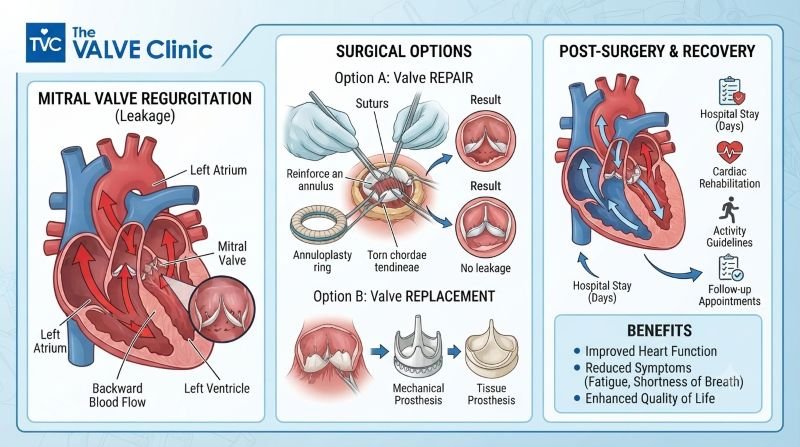
If mitral regurgitation is left untreated, the heart may gradually work harder to compensate for blood leaking backward through the mitral valve. Mild cases may remain stable with regular monitoring, but significant or severe mitral regurgitation can eventually cause heart enlargement, atrial fibrillation, pulmonary hypertension, and heart failure. When treatment becomes necessary, mitral valve regurgitation surgery may help prevent further heart damage and improve long-term outcomes.
That does not mean every patient with mitral regurgitation needs immediate surgery. The right approach depends on the severity of the leak, symptoms, heart function, valve anatomy, and the underlying cause. The important point is to identify when monitoring is appropriate and when delaying treatment may allow permanent changes to the heart.
What Is Mitral Regurgitation and Why Does It Matter?
Mitral regurgitation occurs when the mitral valve does not close completely. When the left ventricle contracts, some blood moves backward into the left atrium instead of flowing forward into the aorta.
A small amount of leakage may cause no symptoms and may simply require periodic echocardiograms. However, as the amount of regurgitation increases, the heart has to handle an additional volume of blood with every heartbeat.
Over time, this extra workload can cause the left atrium and left ventricle to enlarge. Pressure can also build up in the blood vessels supplying the lungs. These changes are important because they can eventually affect both heart function and a patient’s ability to perform normal activities.
If you have recently been diagnosed with the condition, you can also read our detailed guide on mitral valve regurgitation symptoms and treatment to understand the symptoms, causes, diagnosis and treatment options.
What Are the Main Mitral Regurgitation Complications?
The consequences of untreated mitral regurgitation are not the same for everyone. Mild disease can remain stable for years, while severe leakage can progressively affect the heart.
Enlargement of the Heart Chambers
When blood repeatedly leaks backward, the left atrium receives more blood than it normally should. Over time, it may enlarge.
The left ventricle can also enlarge because it has to pump a greater volume of blood with each heartbeat. This is one reason regular echocardiographic monitoring is important even when you feel well.
Atrial Fibrillation
An enlarged left atrium can increase the likelihood of abnormal heart rhythms, particularly atrial fibrillation.
Atrial fibrillation can cause palpitations, fatigue and reduced exercise tolerance. It is also clinically important because it can increase the risk of blood clots and stroke.
Pulmonary Hypertension
As mitral regurgitation progresses, pressure can be transmitted backward toward the lungs.
This may result in pulmonary hypertension and can contribute to increasing breathlessness. In more advanced disease, fluid may accumulate in the lungs, making breathing particularly difficult when lying down.
Heart Failure
This is one of the most important concerns with severe, untreated mitral regurgitation.
The heart may initially compensate for the extra workload. Over time, however, the heart muscle can become enlarged and less efficient. If this progresses, patients may develop symptoms of heart failure such as breathlessness, fatigue, reduced exercise capacity and swelling of the legs or ankles.
The aim of timely treatment is not simply to make a patient feel better. In appropriately selected patients, intervention can also help prevent irreversible deterioration of heart function. Current ACC/AHA guidance recommends intervention for symptomatic severe primary mitral regurgitation and for certain asymptomatic patients when there is evidence of left-ventricular dysfunction.

What Happens When Severe Mitral Regurgitation Is Ignored?
Severe mitral regurgitation deserves particular attention because the heart may continue compensating even while structural changes are developing.
Some patients are surprised when I tell them that feeling reasonably well does not always mean the valve is harmless. The heart can compensate for a significant leak for a period of time. The concern is what happens when that compensation begins to fail.
Possible warning signs include:
- Breathlessness while walking or climbing stairs
- Reduced exercise tolerance
- Increasing tiredness
- Palpitations or an irregular heartbeat
- Breathlessness when lying flat
- Waking during the night because of breathing difficulty
- Swelling of the feet or ankles
- A noticeable decline in everyday physical activity
These symptoms should not automatically be attributed to ageing or lack of fitness. They can indicate that mitral regurgitation is beginning to affect heart function.
The important question is not simply, “Do I have mitral regurgitation?” It is, “How severe is the regurgitation, and what effect is it having on my heart?”
When Is Mitral Valve Regurgitation Surgery Considered?
Not everyone with mitral regurgitation requires an operation.
Treatment decisions are based on several factors, including:
- Severity of the valve leak
- Presence and progression of symptoms
- Left ventricular function
- Size of the heart chambers
- Pulmonary pressures
- Cause of the regurgitation
- Overall health and surgical risk
- Whether the valve can be repaired successfully
For severe primary mitral regurgitation, intervention is recommended in symptomatic patients. In certain patients who have no symptoms but are showing evidence of declining left ventricular function, intervention may also be recommended.
When intervention is required, mitral valve regurgitation surgery may involve repairing the patient’s own valve or replacing it when repair is not appropriate.
Mitral Valve Repair
Whenever a durable repair is technically possible, preserving the patient’s own mitral valve is generally preferred for degenerative primary mitral regurgitation.
Repair can involve different surgical techniques depending on exactly what has caused the valve to leak.

Mitral Valve Replacement
If the valve is too damaged or complex to repair reliably, mitral valve replacement may be considered.
Replacement involves removing or replacing the diseased valve with a prosthetic valve. The choice between a mechanical and tissue valve depends on factors such as age, medical history, lifestyle and long-term treatment considerations.
You can learn more about mitral valve replacement and how the decision is made.
Is Open-Heart Surgery the Only Option?
No. This is an important point for patients and families to understand.
The appropriate treatment depends on the type of mitral regurgitation and the patient’s surgical risk and valve anatomy. For selected patients, catheter-based procedures can provide an alternative to conventional surgery.
One such treatment is transcatheter edge-to-edge repair, commonly known as MitraClip or TEER. A small device is delivered through a catheter and used to bring the mitral valve leaflets together, reducing the amount of backward blood flow.
TEER may be considered for appropriately selected patients with significant mitral regurgitation who are at high or prohibitive surgical risk, as well as selected patients with secondary mitral regurgitation despite appropriate medical therapy.
You can read more about MitraClip and TEER treatment and how this catheter-based approach is used for selected patients.
For some patients with complex valve disease who are not suitable for conventional surgery or repair, transcatheter mitral valve replacement (TMVR) may also be considered.
Mitral Valve Surgery in Mumbai: Why Individual Assessment Matters
If you are searching for mitral valve surgery in Mumbai, I would recommend focusing less on a particular procedure and more on whether the treatment is appropriate for your specific valve anatomy and heart function.
A good assessment should answer:
- How severe is the regurgitation?
- Is the leakage primary or secondary?
- Is the heart beginning to enlarge or weaken?
- Can the valve be repaired?
- Would TEER/MitraClip be appropriate?
- Is replacement necessary?
- Is it safe to continue monitoring?
These questions are often more important than simply asking whether surgery is required.
Dr. Ankur Phatarpekar Clinical Perspective
In my practice, I try to avoid two extremes with mitral regurgitation: unnecessary intervention on one side and unnecessary delay on the other.
A patient with mild regurgitation and a normal heart does not automatically need surgery. At the same time, a patient with severe regurgitation should not wait for symptoms to become unbearable before discussing treatment.
When I assess a patient, I particularly look at:
- The severity and mechanism of the mitral leak
- Symptoms and how they affect daily activity
- Left ventricular size and function
- Left atrial enlargement
- Pulmonary pressures
- The likelihood of a durable valve repair
- Whether a catheter-based treatment such as TEER could be appropriate
- The patient’s age, health and surgical risk
My goal is to intervene at the right time, not simply as early as possible and not after the heart has already suffered avoidable damage.
If you have been told that you have severe mitral regurgitation, I would encourage you to have the echocardiogram and other reports reviewed carefully before making a decision. In some cases, a second opinion can clarify whether monitoring, repair, replacement or a minimally invasive approach is the most appropriate next step.

How Is Mitral Regurgitation Monitored Before Treatment?
If immediate intervention is not required, regular follow-up becomes important.
An echocardiogram is central to monitoring because it allows the cardiology team to assess the severity of leakage and look for changes in the heart chambers and pumping function. Depending on the patient’s condition, other investigations may also be appropriate.
Monitoring should not mean simply waiting without a plan.
Your follow-up should establish:
- When your next echocardiogram is needed
- Which symptoms should prompt an earlier review
- Whether the severity of regurgitation is changing
- Whether heart size or function is changing
- Whether the timing of intervention needs to be reconsidered
The purpose of monitoring is to identify the right treatment window before significant and potentially irreversible heart damage develops.
Frequently Asked Questions About Untreated Mitral Regurgitation
If you have been diagnosed with mitral regurgitation, these are some of the questions I commonly see patients asking about its progression and treatment.
Q. What symptoms may indicate that mitral regurgitation is affecting the heart?
Breathlessness during activity, reduced exercise tolerance, tiredness, palpitations, difficulty breathing when lying down, or swelling around the feet and ankles may indicate that the condition is beginning to affect heart function.
Q. When does mitral valve regurgitation surgery become necessary?
Mitral valve regurgitation surgery may be considered when the leak is severe and symptoms develop, or when tests show that the heart’s pumping function is beginning to decline. The decision also depends on valve anatomy, the cause of the leak, and the patient’s overall health.
Q. What problems can develop when mitral regurgitation progresses?
Progressive mitral regurgitation complications can include enlargement of the left atrium and left ventricle, atrial fibrillation, pulmonary hypertension, and eventually heart failure. Regular echocardiograms can help identify these changes before they become advanced.
Q. Why can severe mitral regurgitation be concerning even without major symptoms?
With severe mitral regurgitation, the heart may compensate for the leaking valve for some time, so a person may feel relatively well while structural changes are developing. Monitoring heart size, pumping function, symptoms, and pulmonary pressures helps determine the appropriate time for treatment.
Q. When might mitral valve replacement be recommended instead of repair?
Mitral valve replacement may be considered when the diseased valve is too damaged or complex to repair reliably. The choice between a mechanical and tissue valve depends on factors such as age, medical history, lifestyle, and long-term treatment considerations.
Q. What should I consider when looking for mitral valve surgery in Mumbai?
When considering mitral valve surgery in Mumbai, focus on an individual assessment rather than a particular procedure. The evaluation should consider the severity and cause of the leak, valve anatomy, heart function, surgical risk, and whether repair, replacement, TEER, or continued monitoring is appropriate.
The Valve Clinic: Making the Right Decision at the Right Time
If you have been diagnosed with mitral regurgitation, my advice is not to panic, but also not to ignore it.
The right treatment is highly individual. Sometimes the safest decision is continued monitoring. Sometimes the valve should be repaired before the heart develops permanent changes. For patients at higher surgical risk, a catheter-based option such as TEER/MitraClip may be worth evaluating.
At The Valve Clinic, I review the patient’s symptoms, echocardiogram, valve anatomy, heart function and overall health before recommending a treatment pathway. If you have already been advised to undergo surgery, a second opinion can also help you understand whether repair, replacement, TEER or continued monitoring is appropriate in your particular situation.
Phone: +91 90045-06263
Email: thevalveclinic@gmail.com
Address: 11th Floor, Diamond Plaza, 1101, Chabildas Rd, Opp. Plaza Cinema, Dadar West, Dadar, Mumbai, Maharashtra 400028, India
If you have a recent echocardiogram or have been told that your mitral regurgitation is severe, you can contact The Valve Clinic to discuss your reports and understand the available treatment options.