If you’ve been experiencing increasing breathlessness, fatigue, or a noticeable decline in your ability to stay active, it may not simply be a part of ageing. In some people, these changes are caused by severe aortic stenosis, a condition where the heart’s aortic valve becomes severely narrowed. When symptoms become significant, treatment is often necessary, and for selected patients, TAVI (Transcatheter Aortic Valve Implantation) may offer an aortic valve replacement without open surgery.
For many people, the changes happen so gradually that they hardly notice them.
- The evening walk becomes shorter.
- The stairs feel steeper.
- Activities that once felt effortless suddenly require planning.
Most people assume they’re slowing down because they’re getting older. Their families often think the same. But sometimes, the heart is trying to tell a different story. One of the most common yet frequently overlooked causes of breathlessness in older adults is severe aortic stenosis.
Understanding the condition early can make a meaningful difference to both quality of life and long-term heart health.
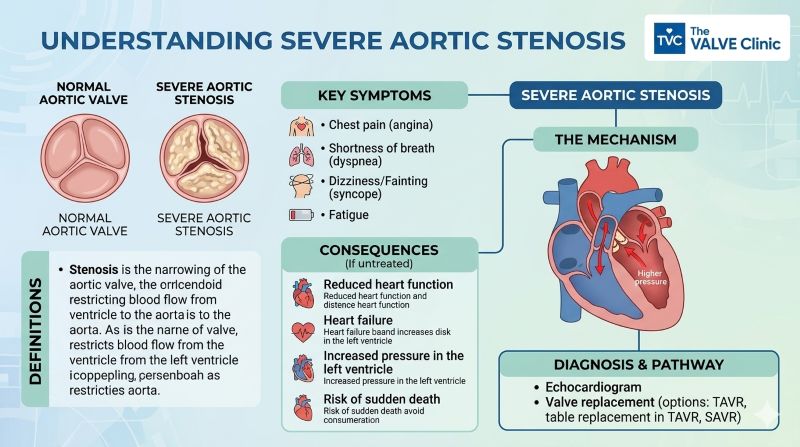
Understanding Severe Aortic Stenosis
The heart contains four valves that help direct blood flow in the correct direction. One of these is the aortic valve, which sits at the exit of the heart and opens with every heartbeat to allow oxygen-rich blood to flow to the rest of the body.
- In aortic stenosis, this valve gradually becomes stiff and narrowed.
- Instead of opening fully, it opens only partially, forcing the heart to work harder to push blood through the restricted opening.
- Over time, the extra effort places significant strain on the heart muscle.
- When the narrowing becomes severe, the condition is known as severe aortic stenosis.
At this stage, symptoms often begin to appear and treatment may become necessary.
Why Does the Aortic Valve Become Narrow?
In most older adults, the narrowing develops because calcium gradually accumulates on the valve leaflets over many years. This process is somewhat similar to how joints can become stiffer with age. Less commonly, people may be born with an abnormal valve structure that becomes problematic later in life. In some patients, previous rheumatic heart disease may contribute to valve damage and narrowing. Regardless of the cause, the result is the same: blood cannot move through the valve as efficiently as it should.
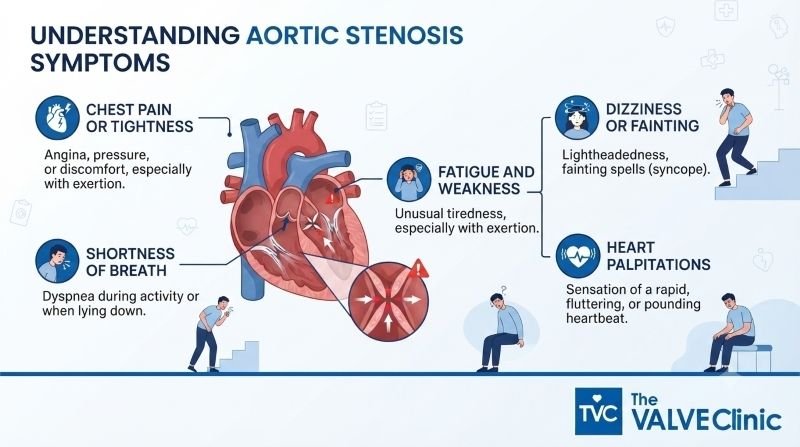
Recognising Aortic Stenosis Symptoms
One of the challenges with severe aortic stenosis is that symptoms often develop gradually. Many patients adapt without realising it. They unconsciously slow their pace, avoid physical activity, or take more frequent breaks.
Common aortic stenosis symptoms include:
- Breathlessness during activity
- Reduced exercise tolerance
- Unusual fatigue
- hest discomfort or pressure
- Dizziness or light-headedness
- Episodes of fainting
- Reduced ability to perform routine activities
What matters most is not whether these symptoms occur occasionally, but whether they represent a clear change from your normal level of functioning. A person who could comfortably walk for thirty minutes a year ago but now struggles after ten minutes should not simply assume it is ageing.
Why Severe Aortic Stenosis Should Not Be Ignored
The heart is remarkably adaptable. For years, it may compensate for a narrowing valve by working harder. Eventually, however, compensation reaches its limits. The heart muscle may begin to weaken. Fluid may build up in the lungs. Symptoms become more noticeable and daily life becomes increasingly restricted. Once significant symptoms develop in severe aortic stenosis, the risk of serious complications rises if the condition remains untreated. This is why timely evaluation is so important. The goal is not to create alarm. The goal is to avoid unnecessary delay.
How Doctors Diagnose Severe Aortic Stenosis
Diagnosis usually begins with a consultation, examination, and imaging tests. The most important test is an echocardiogram, which is an ultrasound scan of the heart.
This allows doctors to evaluate:
- How narrow the valve has become
- How well the heart muscle is functioning
- The severity of blood flow obstruction
- Whether other valves are affected
Additional imaging may be recommended depending on the patient’s condition and treatment planning needs. Importantly, doctors do not make decisions based solely on a scan. Symptoms, overall health, activity levels, and heart function all contribute to determining the best treatment approach.

When Does Severe Aortic Stenosis Require Treatment?
Not every patient with aortic valve narrowing needs immediate intervention. Patients with mild or moderate disease may simply require regular monitoring.
However, treatment is generally considered when:
- The narrowing becomes severe
- Symptoms are present
- Heart function begins to decline
- The condition starts affecting quality of life
Historically, treatment meant open-heart surgery to replace the valve. Today, that is no longer the only option.
What Is TAVI?
TAVI, or Transcatheter Aortic Valve Implantation, is a minimally invasive procedure used to replace a diseased aortic valve. Instead of opening the chest, doctors guide a replacement valve to the heart through blood vessels, most commonly via an artery in the leg. The new valve is positioned inside the diseased valve and begins functioning immediately. Because the chest is not opened and the heart does not need to be stopped, recovery is often faster than with traditional surgery. TAVI has transformed the treatment landscape for many patients with severe aortic stenosis.
Who Is Eligible for TAVI?
One of the most common questions patients ask is whether they qualify for TAVI. The answer depends on several factors.
TAVI eligibility is determined through a detailed assessment that includes:
- Age and overall health
- Severity of symptoms
- Valve anatomy
- Imaging findings
- Surgical risk
- Existing medical conditions
Many patients assume age alone determines eligibility. It doesn’t. Some patients in their eighties are excellent candidates for TAVI, while younger patients may benefit more from surgery. The decision is highly individual.
A Perspective from Our Structural Heart Team
One of the most common misconceptions we encounter is that every elderly patient should automatically have TAVI and every younger patient should undergo surgery. In reality, treatment decisions are rarely that simple. When evaluating severe aortic stenosis, we look at the entire picture. Valve anatomy, heart function, overall health, lifestyle goals, and procedural safety all matter. The best treatment is not necessarily the least invasive treatment. The best treatment is the one most likely to deliver a safe procedure, durable results, and meaningful improvement in quality of life.
A Patient Story That Reflects a Common Journey
A gentleman in his late seventies came for evaluation after months of gradually worsening breathlessness.
- He had not stopped his daily activities entirely.
- He had simply reduced them.
- Shorter walks.
- More frequent rests.
- Less participation in family outings.
- His echocardiogram revealed severe aortic stenosis.
- The diagnosis surprised him because the symptoms had developed so slowly.
- Following detailed imaging and heart team review, he was found to be a suitable candidate for TAVI.
- The procedure went well.
- Recovery was gradual rather than dramatic.
Over the following weeks, he noticed that daily activities felt easier again. The most important outcome was not that he underwent TAVI. It was that he sought evaluation before the condition progressed further.
How Long Does Recovery After TAVI Usually Take?
Many patients are surprised by how quickly recovery begins after TAVI. Most patients are encouraged to sit up and walk soon after the procedure. Hospital stays are often shorter than those associated with traditional open-heart surgery.
- However, recovery is still a process.
- Energy levels improve gradually.
- Medications may need adjustment.
- Follow-up appointments remain essential.
- Every patient recovers at a different pace.
When Should You Speak to a Heart Valve Specialist?
If you have been experiencing:
- Increasing breathlessness
- Reduced stamina
- Unexplained fatigue
- Dizziness during exertion
- Fainting episodes
- Progressive decline in activity levels
It may be worth discussing these symptoms with a heart valve specialist. Many people live with symptoms for months or even years before seeking help. Often, the greatest benefit comes not from immediate treatment but from understanding what is causing the symptoms in the first place.
FAQs
Q. What are the first signs of severe aortic stenosis?
The earliest signs often include breathlessness during activity, fatigue, reduced stamina, dizziness, or chest discomfort. Many patients initially mistake these symptoms for normal ageing.
Q. Can severe aortic stenosis be treated without open-heart surgery?
Yes. In selected patients, TAVI provides an aortic valve replacement without open surgery. Eligibility depends on anatomy, overall health, and specialist assessment.
Q. How do doctors determine TAVI eligibility?
TAVI eligibility is determined through imaging tests, symptom assessment, evaluation of overall health, and review by a structural heart team experienced in valve disease.
Q. Is TAVI safer than surgery?
TAVI may offer lower procedural risk for some patients, particularly those considered high-risk for surgery. However, surgery remains the best option for certain patients. The safest approach depends on individual circumstances.
Q. What happens if severe aortic stenosis is left untreated?
Once symptoms develop, untreated severe aortic stenosis can lead to worsening heart function, heart failure, reduced quality of life, and increased risk of serious complications.
Q. Is breathlessness always caused by severe aortic stenosis?
No. Breathlessness can occur due to several heart and lung conditions. Proper evaluation is necessary to identify the underlying cause and determine the most appropriate treatment.