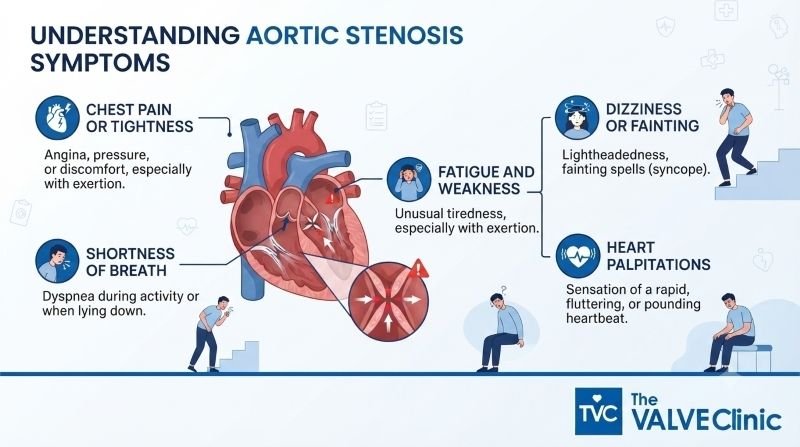
Aortic stenosis symptoms often appear as subtle changes in everyday activity before patients realise that a heart valve may be responsible. Breathlessness while walking, unusual tiredness, chest discomfort, dizziness, or a gradual reduction in exercise capacity can indicate that the aortic valve has become narrowed. Diagnosis usually involves an echocardiogram, and treatment depends on disease severity, symptoms, heart function, anatomy, age, and overall health.
Could Your Everyday Symptoms Be Coming From the Aortic Valve?
Aortic stenosis develops when the aortic valve becomes narrowed and cannot open normally.
The valve has an important job. Every time the heart contracts, it opens to allow blood to leave the left ventricle and travel through the aorta to the rest of the body.
When the valve becomes stiff or narrowed, the heart has to work harder to push blood through it.
The difficulty is that aortic stenosis does not always announce itself clearly.
A patient may not experience a sudden change. Instead, everyday activities gradually become harder.
You may notice that:
- You cannot walk as far as you used to.
- You become breathless when climbing stairs.
- You need to stop while walking outdoors.
- You feel unusually tired after routine activities.
- You avoid activities that previously felt comfortable.
- You experience dizziness during exertion.
- You develop chest pressure or discomfort.
- You occasionally feel faint or actually lose consciousness.
These changes deserve attention, particularly when they are new or progressively worsening.
One of the questions I ask my patients is simple: “What could you do six months ago that you cannot comfortably do today?”
That answer can sometimes be more informative than simply asking whether you have symptoms.
What Causes Aortic Stenosis?
There are several aortic stenosis causes, and the cause can influence how the disease develops and how we approach treatment.
Age-Related Valve Changes
With increasing age, calcium can accumulate on the aortic valve. The leaflets gradually become thicker and less mobile.
This process can eventually cause significant narrowing.
Importantly, this is not simply a matter of the valve becoming “old.” Once the valve becomes severely narrowed, the obstruction can place considerable stress on the heart.
Bicuspid Aortic Valve
Most people are born with an aortic valve that has three leaflets. Some people are born with a bicuspid valve, which has two.
A bicuspid valve can become narrowed earlier in life than a typical three-leaflet valve.
Patients with a bicuspid valve may also require monitoring of the aorta because abnormalities of the aortic wall can occur alongside the valve problem.
Rheumatic Heart Disease
Rheumatic fever can cause permanent damage to heart valves. Scarring and thickening can eventually interfere with normal valve opening.
This remains an important cause of valve disease in parts of the world where rheumatic heart disease is prevalent.
Other Factors
Conditions such as high blood pressure, diabetes, high cholesterol, and kidney disease may coexist with calcific valve disease and contribute to overall cardiovascular risk.
Managing these conditions is important for your heart health, although medicines cannot reverse severe mechanical narrowing of the aortic valve.

Aortic Stenosis Diagnosis: What Do the Tests Actually Tell You?
A suspected aortic stenosis diagnosis does not depend on symptoms alone.
Your cardiologist combines your medical history, examination findings, imaging results, and heart function to understand the complete picture.
The Heart Murmur
A doctor may hear an abnormal sound through a stethoscope when blood passes through a narrowed aortic valve.
A murmur can raise suspicion, but it cannot tell us precisely how severe the valve narrowing is.
That is where imaging becomes important.
Echocardiography: The Main Test
An echocardiogram uses ultrasound to examine the heart and valves.
It can help determine:
- How well the left ventricle is functioning
- How quickly blood moves through the narrowed valve
- The pressure gradient across the valve
- The estimated valve opening area
- Whether other valves are affected
- Whether the heart muscle has become thickened
This information helps classify the severity of the disease.
CT Imaging
CT has become particularly valuable when we are considering a catheter-based valve replacement such as TAVI.
It provides detailed information about:
- The aortic valve
- Calcium distribution
- The aortic root
- The coronary arteries
- The size and shape of the arteries used for valve delivery
- The relationship between important cardiac structures
In other words, the echocardiogram helps us understand how the valve is functioning, while CT can help us understand whether the patient’s anatomy is suitable for a particular intervention.
Additional Testing
Depending on the patient, doctors may also consider:
- Exercise testing
- Electrocardiography
- Cardiac CT
- Cardiac MRI
- Coronary angiography
- Blood tests
Not every patient needs every test. The investigation should answer a clinical question rather than become a checklist.
Aortic Stenosis Stages: When Does Monitoring Become Treatment?
One of the most important questions after diagnosis is:
“Do I need treatment now, or can we continue monitoring the valve?”
The answer depends on more than the word “severe” appearing on an echocardiogram.
Doctors consider the stage of disease, symptoms, heart function, valve measurements, rate of progression, and other clinical findings.
Early Disease
In mild disease, the valve may show some abnormality without creating a significant obstruction.
At this stage, regular monitoring may be all that is necessary.
Progressive Disease
As narrowing increases, the valve begins to restrict blood flow more significantly.
You may still have few or no symptoms.
This is where regular follow-up becomes particularly important because the valve can progressively worsen over time.
Severe Aortic Stenosis Without Obvious Symptoms
This situation requires careful assessment.
Some patients genuinely have no symptoms. Others have unknowingly reduced their activity and therefore no longer perform enough exertion to trigger symptoms.
For example, someone who previously walked several kilometres but now spends most of the day at home may say they feel completely well.
I therefore look at functional capacity, not just the answer to “Do you have breathlessness?”
Severe Symptomatic Aortic Stenosis
When severe valve narrowing is clearly responsible for symptoms, the conversation changes.
At this point, the question is generally no longer whether the valve is abnormal. The important question becomes which treatment is appropriate and when should it be performed?

Aortic Stenosis Treatment: It Is Not One-Size-Fits-All
The right aortic stenosis treatment depends on the individual patient.
For some people, monitoring remains appropriate. For others, valve replacement becomes necessary.
There are two major valve replacement approaches: surgical aortic valve replacement and transcatheter aortic valve implantation.
Medical Management and Monitoring
There is currently no medicine that can physically remove severe narrowing from a calcified aortic valve.
However, medicines can treat other conditions that may accompany aortic stenosis, such as high blood pressure, fluid retention, or abnormal heart rhythms.
Patients with mild or moderate disease may require periodic clinical reviews and echocardiograms.
The frequency depends on the severity and progression of the valve disease.
Surgical Aortic Valve Replacement
Surgical aortic valve replacement involves removing or replacing the diseased valve through cardiac surgery.
Surgery remains an important option and can be particularly appropriate when the patient has other conditions that can be treated during the same operation.
For example, a patient may have aortic stenosis along with coronary artery disease or an aortic abnormality requiring surgical treatment.
In such circumstances, surgery may provide advantages that a catheter-only approach cannot.
TAVI: A Catheter-Based Valve Replacement
TAVI, or transcatheter aortic valve implantation, provides another way to replace a diseased aortic valve.
Instead of opening the chest for conventional valve surgery, doctors deliver a replacement valve through a catheter.
In many patients, the catheter enters through an artery in the groin and travels toward the heart. The new valve is positioned inside the diseased aortic valve.
TAVI has significantly expanded treatment options for patients with severe aortic stenosis.
However, I would not recommend choosing TAVI simply because it is less invasive.
The important question is whether it is the right procedure for you.
TAVI or Surgery: How Do We Decide?
Patients often ask me:
“Doctor, should I have TAVI or surgery?”
There is no responsible answer without first reviewing the individual patient.
I consider several factors:
Age and Long-Term Planning
A younger patient may have very different long-term considerations from an older patient.
Valve durability, the possibility of future procedures, coronary access, and lifetime management all become relevant.
Valve Anatomy
A CT scan can reveal details that influence whether TAVI is technically suitable.
Bicuspid valves, unusual anatomy, heavy calcium, coronary artery positioning, and vascular access can all influence the decision.
Other Heart Problems
If you also have coronary artery disease requiring bypass surgery, another valve problem, or an aortic condition that requires surgical treatment, surgery may be more appropriate.
Surgical Risk
Your general health, previous operations, kidney function, lung disease, frailty, and other factors can influence surgical risk.
Your Priorities
Medical decisions should also reflect what matters to you.
For one patient, avoiding open surgery may be particularly important. Another patient may prioritise a long-term surgical strategy based on age and anatomy.
The best decision comes from putting all these factors together rather than comparing procedures in isolation.
For a more detailed comparison, you can read about TAVI vs open-heart surgery and how doctors assess the two approaches.
Dr. Ankur Phatarpekar Clinical Perspective
When I meet someone with aortic stenosis, I do not start the discussion by asking whether they want TAVI or surgery.
I first want to understand the patient.
- What symptoms are they experiencing?
- How much has their activity changed?
- What does the echocardiogram show?
- Is the heart still functioning normally?
- What does the CT tell us about the valve and surrounding anatomy?
- Are there other cardiac problems that need attention?
These questions help separate a patient who simply needs monitoring from someone who should be evaluated for valve replacement.
I also believe patients should understand why a particular treatment has been recommended.
If I suggest TAVI, I should be able to explain why the patient’s anatomy and overall circumstances make it a reasonable option. If I recommend surgery, I should explain what additional benefit surgery may provide.
A minimally invasive procedure is not automatically the best procedure.
My goal is to select an approach that makes sense not only for the next few weeks, but also for the patient’s longer-term cardiac health.
This is especially important because valve replacement is not simply about fixing a number on an echocardiogram. We are making a decision that can influence the patient’s quality of life and future treatment options.
When to See a Doctor for Possible Aortic Stenosis
You should speak with a doctor if you notice a persistent or unexplained change in your physical ability.
Pay particular attention to:
- Breathlessness when walking or climbing stairs
- Chest discomfort during activity
- Dizziness or light-headedness
- Fainting
- Unexplained fatigue
- Reduced exercise tolerance
- Swelling in the legs
- A noticeable decline in everyday activity
If you already know that you have aortic stenosis, do not ignore a change in your symptoms.
A patient who was previously stable but develops new breathlessness or chest discomfort may need reassessment.
Similarly, if your echocardiogram shows significant valve narrowing but you feel well, regular follow-up remains important.
The absence of symptoms does not always mean the valve disease is insignificant.
Frequently Asked Questions About Aortic Stenosis
Patients usually have very practical questions after receiving an aortic stenosis diagnosis. Here are some of the questions I commonly encounter.
Q. What are the first aortic stenosis symptoms?
Early aortic stenosis symptoms can be subtle. You may notice reduced exercise capacity, breathlessness during activity, tiredness, dizziness, or difficulty completing activities that were previously comfortable. Some patients have no symptoms in the early stages.
Q. What are the main aortic stenosis causes?
Common aortic stenosis causes include calcium buildup associated with ageing, a bicuspid aortic valve, and rheumatic valve disease. The underlying cause can influence how the condition develops and how doctors approach long-term management.
Q. How Is Aortic Stenosis Diagnosed?
Aortic stenosis diagnosis usually involves a clinical examination followed by an echocardiogram. Doctors may use CT imaging and other tests when they need more information about valve anatomy, severity, or suitability for a procedure.
Q. What are the Aortic Stenosis Stages?
Doctors generally classify aortic stenosis according to disease progression, severity, symptoms, and the effect on the heart. Patients can move from an early stage requiring observation to severe disease requiring consideration of valve replacement.
Q. Can severe aortic stenosis be treated with medicines?
Medicines can help manage associated conditions, but they cannot physically widen a severely narrowed aortic valve. When severe symptomatic disease requires valve replacement, doctors may consider surgery or TAVI treatment depending on the individual patient’s circumstances.
Q. Is TAVI better than surgical valve replacement?
Neither procedure is automatically better for every patient. TAVI may provide important advantages for appropriately selected patients, while surgery remains preferable in certain anatomical and clinical situations. The decision should follow a detailed assessment by a Heart Team.
For patients comparing these approaches, our guide to TAVI and open-heart surgery explains the main considerations.
Q. When should I see a doctor?
You should seek medical evaluation if you develop unexplained breathlessness, chest discomfort, dizziness, fainting, or a significant reduction in your normal activity level. If you already have aortic stenosis, report new or worsening symptoms to your cardiologist.
The Valve Clinic: Understanding Your Options Before Treatment
An aortic stenosis diagnosis can raise many questions, especially when you hear terms such as severe stenosis, valve replacement, TAVI, or surgery.
You do not need to make that decision based on one echocardiogram report or a general comparison found online.
At The Valve Clinic, I take the time to understand the symptoms, review the imaging, assess the severity of the valve disease, and consider the patient’s overall health and long-term goals. If valve replacement is appropriate, I discuss the available approaches and explain why one option may be more suitable than another.
If you have already received a recommendation for TAVI or surgical valve replacement and would like another clinical opinion, reviewing the complete medical picture can help you make a more informed decision.
Phone: +91 90045-06263
Email: thevalveclinic@gmail.com
Address: 11th Floor, Diamond Plaza, 1101, Chabildas Rd, opp. Plaza Cinema, Dadar West, Dadar, Maharashtra 400028, India
Expert Review
Dr. Ankur Phatarpekar
Interventional Cardiologist & Structural Heart Specialist
The Valve Clinic, Mumbai
This article is intended for general patient education and does not replace an individual medical consultation. Aortic stenosis severity and treatment decisions should be assessed using your symptoms, clinical examination, imaging, medical history, and overall health.