If a patient has been diagnosed with rheumatic mitral stenosis, they may be eligible for a BMV procedure for mitral stenosis when the valve is significantly narrowed, relevant symptoms are present, and the valve anatomy is suitable for balloon treatment. Eligibility depends on echocardiography, valve structure, symptoms, heart rhythm and the absence of important contraindications.
When Is BMV Procedure for Mitral Stenosis Considered?
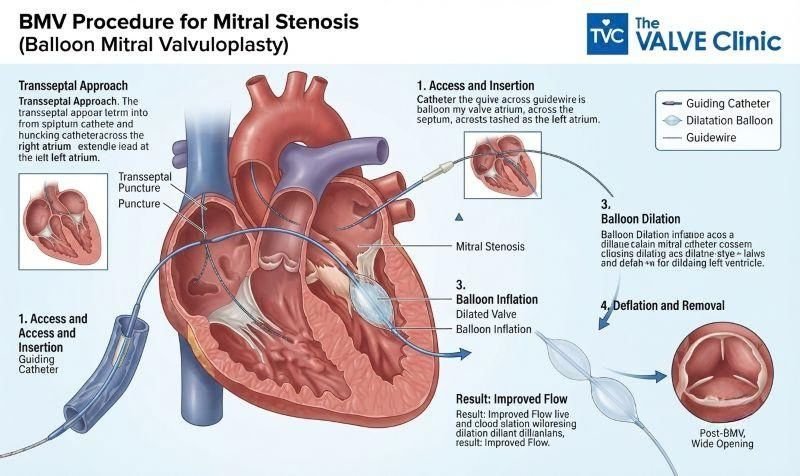
The BMV procedure for mitral stenosis, also called balloon mitral valvotomy or percutaneous mitral commissurotomy, is generally considered when the mitral valve is significantly narrowed and the valve anatomy is suitable for balloon treatment. The procedure uses a catheter-mounted balloon to separate fused valve commissures and improve blood flow through the mitral valve.
However, having mitral stenosis does not automatically mean that BMV is the right treatment. Eligibility depends on the severity of narrowing, symptoms, valve anatomy, mitral regurgitation, left-atrial thrombus and other clinical factors.
During patient assessment, several factors are considered together:
- How severe the mitral stenosis is
- Whether the patient has symptoms
- The mitral valve area and pressure gradient
- The condition and structure of the valve
- The amount of valve calcification
- Whether the commissures are fused
- Whether significant mitral regurgitation is present
- Whether there is a blood clot in the left atrium
- The patient’s heart rhythm and pulmonary pressure
- Whether another heart condition requires surgery
For patients with suitable rheumatic mitral stenosis, BMV can provide an alternative to surgical treatment when the valve anatomy is favourable.
What Makes Someone Eligible for BMV Procedure?
BMV procedure eligibility is based on the complete clinical picture rather than one isolated measurement.
Significant mitral stenosis
The 2025 ESC/EACTS guidelines consider a mitral valve area of around 1.5 cm² or less an important marker when assessing clinically severe rheumatic mitral stenosis. Symptoms and other haemodynamic findings are considered alongside the valve area.
Symptoms may include breathlessness during activity, reduced exercise tolerance, fatigue or, in more advanced cases, breathlessness at rest.
Favourable valve anatomy
The valve needs to have anatomy that can respond appropriately to balloon treatment.
Echocardiography assesses leaflet mobility, thickness, calcification, commissural fusion and the condition of the subvalvular apparatus.
A valve with severe calcification or extensive structural damage may not respond predictably to balloon dilatation.
No significant mitral regurgitation
Mitral regurgitation means that blood leaks backward through the mitral valve. If significant leakage is already present, balloon treatment may increase it. Therefore, the severity of mitral regurgitation is an important part of the assessment before BMV.
No left-atrial thrombus
Patients with mitral stenosis can develop enlargement of the left atrium and atrial fibrillation, which can increase the risk of blood-clot formation.
A left-atrial thrombus is an important contraindication to percutaneous mitral commissurotomy in most circumstances.
What Tests Are Needed Before BMV Procedure?
Before recommending BMV, the assessment needs to answer two important questions: how severe is the narrowing, and can the valve be treated safely and effectively with a balloon?

Echocardiogram
A transthoracic echocardiogram is usually one of the most important investigations. It helps assess:
- Mitral valve area
- Pressure gradient across the valve
- Leaflet mobility
- Valve thickening and calcification
- Commissural anatomy
- Mitral regurgitation
- Pulmonary artery pressure
- Other valve abnormalities
These are among the important tests before BMV procedure that help determine whether the valve is suitable for treatment.
Transoesophageal echocardiography
A TEE can provide a more detailed assessment of the mitral valve and left atrium. It is particularly useful when there is a need to exclude a left-atrial or left-atrial appendage thrombus before intervention.
ECG and clinical assessment
An ECG can identify atrial fibrillation and other rhythm abnormalities. The clinical assessment also considers symptoms, exercise tolerance, previous cardiac procedures and any associated heart disease.
Additional investigations
Depending on the patient’s age, symptoms, medical history and planned intervention, additional blood tests or cardiac investigations may be recommended.
These investigations are not simply a checklist. Together, they help determine whether BMV is appropriate and whether another treatment should be considered.
What Is the Wilkins Score for BMV?
The Wilkins score for BMV is an echocardiographic scoring system used to describe the anatomy of the mitral valve.
Traditionally, it assesses four features:
- Leaflet mobility
- Leaflet thickening
- Leaflet calcification
- Subvalvular thickening
A lower score generally indicates more favourable anatomy for balloon treatment, while a higher score can indicate more complex valve disease.
However, a treatment decision should not be made based only on the Wilkins score.
The 2025 ESC/EACTS guidance identifies an echocardiographic score above 8 as an unfavourable anatomical characteristic, but other factors including commissural morphology and the distribution of calcification also influence suitability.
When Is BMV Procedure Not Recommended?
Understanding BMV procedure contraindications is just as important as knowing who may benefit from treatment.
The 2025 ESC/EACTS guidelines identify several situations in which percutaneous mitral commissurotomy is generally contraindicated, including:
- Mitral valve area above 1.5 cm² in the usual clinical setting
- Left-atrial thrombus
- More than mild mitral regurgitation
- Severe or bi-commissural mitral valve calcification
- Absence of commissural fusion
- Severe associated aortic valve disease or severe combined tricuspid disease requiring surgery
- Coronary artery disease requiring bypass surgery
These points should not be interpreted as a substitute for individual assessment. There can be selected situations where the treatment pathway requires more detailed consideration.
For example, if a patient has a left-atrial appendage thrombus, anticoagulation and repeat imaging may sometimes be considered before reassessing whether intervention is possible.
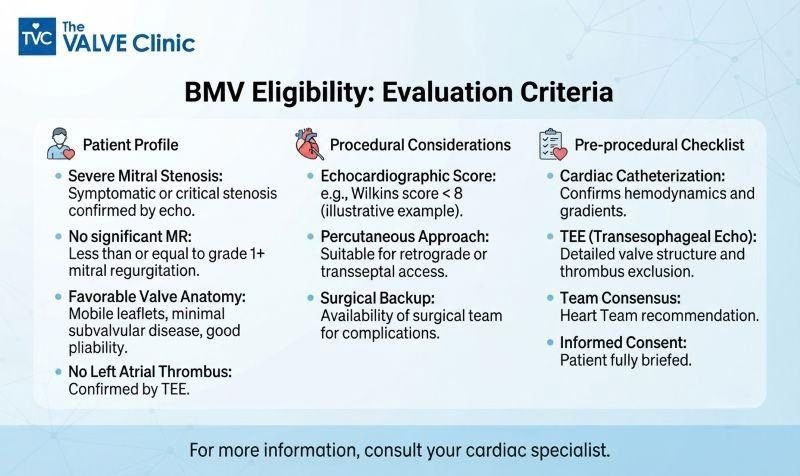
The Valve Clinic Approach to BMV Eligibility
At The Valve Clinic, suitability for BMV is not determined based on symptoms or one echocardiographic measurement alone.
The assessment considers the valve anatomy, severity of stenosis, degree of mitral regurgitation, heart rhythm, left-atrial status, pulmonary pressure and any other significant heart disease.
The practical question is whether opening the valve with a balloon can provide meaningful benefit while keeping the patient’s procedural risk acceptable.
When the valve anatomy is favourable, BMV can be an important minimally invasive treatment option for selected patients with rheumatic mitral stenosis. When the anatomy is unsuitable, alternative treatment options are discussed rather than recommending a procedure simply because the diagnosis appears to fit.
If BMV is not suitable and the valve requires replacement, treatment options may include mitral valve replacement depending on the patient’s anatomy and overall clinical situation.
Dr. Ankur Phatarpekar Clinical Perspective
When a patient asks, “Am I eligible for BMV?”, Dr. Ankur Phatarpekar does not determine eligibility from the diagnosis alone.
He first evaluates the valve, how narrow it is, how mobile the leaflets are, whether calcium is present, whether the commissures are fused and whether there is significant leakage.
He also evaluates what is happening around the valve, particularly the heart rhythm, left atrium, pulmonary pressure and presence of clot.
Once these pieces are available, a more meaningful discussion can take place about whether BMV is appropriate or whether another treatment would be safer and more suitable.
Frequently Asked Questions About BMV Eligibility
Patients commonly want to know whether a diagnosis of mitral stenosis automatically means they need balloon treatment. It does not. Balloon mitral valvotomy eligibility depends on the severity of the disease, valve anatomy, symptoms and the presence or absence of contraindications.
Q. Who is eligible for the BMV procedure?
Patients with significant rheumatic mitral stenosis may be eligible when they have appropriate clinical indications, favourable valve anatomy and no major contraindications.
Q. What mitral valve area is needed for BMV?
A mitral valve area of approximately 1.5 cm² or less is an important threshold when assessing clinically severe rheumatic mitral stenosis. However, valve area alone does not determine eligibility.
Q. Is a Wilkins score of 8 suitable for BMV?
A Wilkins score of 8 or below has traditionally been associated with more favourable valve anatomy. However, the complete echocardiographic assessment is more important than the score alone.
Q. Can BMV be performed if there is a blood clot in the heart?
A left-atrial thrombus is generally a contraindication to percutaneous mitral commissurotomy. In selected circumstances, anticoagulation and repeat imaging may be considered before reassessing eligibility.
Q. Can BMV be done if the mitral valve is leaking?
More than mild mitral regurgitation is generally considered a contraindication because balloon treatment can increase the degree of leakage.
Q. Is BMV suitable for everyone with rheumatic mitral stenosis?
No. Balloon mitral valvotomy eligibility depends on valve anatomy, severity of narrowing, symptoms, heart rhythm, thrombus status, associated valve disease and overall procedural considerations.
Discuss Your BMV Eligibility With Dr. Ankur Phatarpekar
If a patient has been diagnosed with rheumatic mitral stenosis and has been told that BMV may be an option, the next step is a detailed assessment rather than choosing a procedure based on one number from an echocardiography report.
Dr. Ankur Phatarpekar can review the patient’s symptoms, echocardiography and other relevant investigations and help the patient understand whether BMV is appropriate for their particular valve anatomy and clinical situation.
Phone: +91 90045-06263
Email: thevalveclinic@gmail.com
Address: 11th Floor, Diamond Plaza, 1101, Chabildas Rd, opp. Plaza Cinema, Dadar West, Dadar, Mumbai, Maharashtra 400028, India
Reviewed by Dr. Ankur Phatarpekar
Interventional Cardiologist & Structural Heart Specialist
Dr. Ankur Phatarpekar evaluates each patient individually, considering symptoms, echocardiography, valve anatomy and overall cardiac health before recommending BMV.
His approach focuses on helping patients understand whether balloon mitral valvotomy is appropriate for their specific condition.